Early ramp
€0K+
Processed during early ramp
70 SEPA transactions validated payment rails, mandate flow, and operational handling.
Pilot phase
HubSpot's payment infrastructure was primarily built for North American customers.
European enterprise deals were consistently delayed or lost due to lack of native bank payment support. Without SEPA Direct Debit, customers faced friction completing payments, sales teams relied on manual workarounds, and the business had limited payment flexibility in key European markets.
Launching SEPA required more than introducing a new payment option. The platform needed to support:
This shifted the project from a checkout feature into a broader platform and operational design initiative.
I led UX across multiple product surfaces and teams. My work included:
To align Product, Engineering, Legal, Billing, and Operations teams around the rollout, I created a shared planning deck that mapped customer journeys, operational dependencies, legal requirements, engineering milestones, and launch sequencing across the SEPA pilot — connecting customer experience, compliance, operations, and platform behaviour.

To understand the impact of introducing SEPA into a card-first ecosystem, I worked closely with Sales, Legal, Billing, Product, Engineering, and Finance Ops teams to map customer journeys, operational dependencies, and payment lifecycle behaviour.
The discovery phase uncovered a few critical themes:
These insights directly shaped the phased rollout strategy, pilot scope, and operational planning for SEPA expansion.
SEPA Rollout Strategy & Opportunity MappingTo balance speed, compliance, and scalability, the rollout was intentionally divided into two phases.
The first release focused on a controlled launch in Germany. Germany had strong SEPA demand and specific localisation requirements — starting here allowed us to validate the payment rails, mandate experience, legal language, and operational handling before wider rollout.
After validating the pilot, we expanded toward a scalable self-service model — including self-service checkout, existing customers switching payment methods, account & billing management, expansion across SEPA-supported countries, ramp monitoring, and localised communication patterns.
To align teams around rollout scope, operational dependencies, localisation requirements, and customer lifecycle behaviour, I created a shared rollout and ecosystem planning artifact used across Product, Engineering, Billing, Legal, and Operations teams.
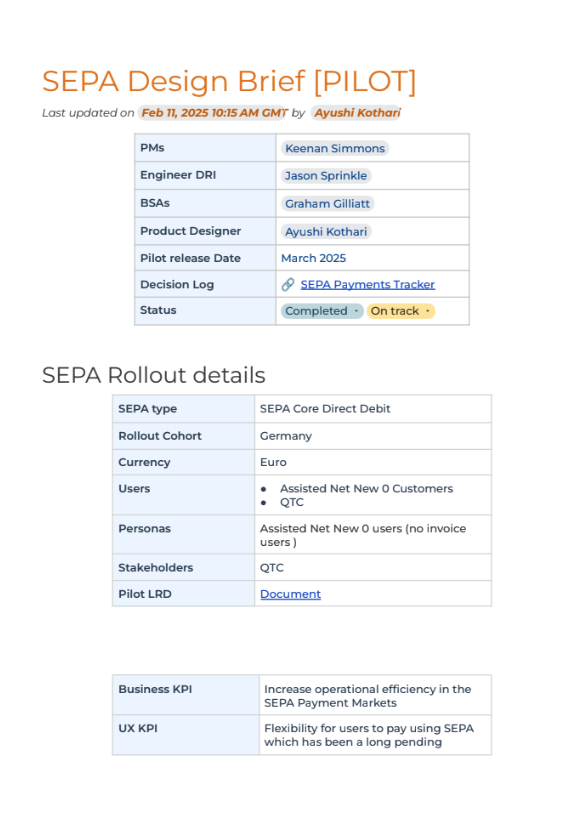
The launch impacted multiple layers of the ecosystem, not just the checkout experience.
Customer Layer — Users needed to select SEPA as a payment method, review and authorise mandate details, understand payment timing, manage their bank account information, and receive clear communication around payment states and outcomes.
Internal Team Layer — Sales, Support, and Finance Ops teams needed visibility into payment states, settlement behaviour, and operational actions required during delayed payment processing — reducing unnecessary escalations and supporting manual intervention.
System Layer — The platform needed to support mandate storage, payment initiation through Adyen, delayed settlement handling, billing updates, lifecycle communication, and failure or chargeback management.
Mapping these layers early helped align teams around the broader operating model required for SEPA to scale successfully.
Four decisions that shaped how the rollout balanced speed, trust and scale.
The design work focused on the end-to-end payment lifecycle rather than isolated screens. Key journeys included sales-assisted SEPA setup, mandate authorisation, payment visibility in Account & Billing, payment lifecycle communication, and payment state handling across successful, pending, failed, and retry scenarios.
I also worked closely with Engineering teams to validate payment behaviour through Adyen's test environment before finalising lifecycle messaging and status communication patterns.
The final solution connected Sales quoting, Checkout, Billing, and operational visibility into a more unified payment experience while supporting localisation and future scalability.
The rollout introduced native SEPA Direct Debit support and created a scalable foundation for future expansion.
70 SEPA transactions validated payment rails, mandate flow, and operational handling.
Pilot phase233 payments confirmed demand and operational readiness at scale.
30 days post-launchEnterprise customers moved off expensive card payments to a credible, lower-cost bank-to-bank alternative.
Structural shiftAccurate lifecycle states meant fewer "where's my payment?" tickets and fewer Finance Ops escalations.
OperationsBeyond revenue impact, the project improved operational visibility into payment lifecycle states and established scalable patterns for handling asynchronous bank payments across the platform ecosystem.
SEPA didn't just ship — it moved meaningful volume in its first thirty days.
This project was not simply about launching another payment method. It required designing a scalable operating model for introducing a new payment behaviour across customer journeys, internal operations, billing systems, and compliance workflows.
My contribution extended beyond execution into rollout strategy, systems thinking, operational design, and cross-functional alignment. One of the most valuable aspects of the project was proactively identifying how delayed bank settlement would affect billing states, lifecycle communication, and operational workflows before those issues became customer-facing problems.
The experience strengthened my approach to designing platform-level systems, aligning multiple teams around shared operational goals, and shaping scalable experiences beyond the visible UI layer.